
How SEBI read manipulation off trade structure, and the appeal that is still unresolved
The third of a three-part series on how Indian index options settle. The previous post derived the mathematics of "marking the close," a way to bend a volume-weighted-average settlement to a large options book. This post is the real case that mathematics fits.
On 3 July 2025, SEBI issued a 105-page ex-parte interim order against four Jane Street entities and impounded ₹4,843.57 crore in alleged unlawful gains, accusing the firm of bending Indian index settlements to suit its own options book. The number became folklore inside a day.
The mechanism, which the previous post derives in full, is short to state. An Indian index derivative settles not on the closing price but on the volume-weighted average of the underlying over the last half hour. If you hold a large options position that profits when that average comes in low, and you are big enough to move the index by trading its constituents, you can sell steadily across the settlement window to drag the average your way, losing a little on the selling and gaining far more on the options. The mathematics says two things about this: the cost-minimising way to do it is to spread the pressure across the window rather than slam the close, and it only pays when the options book is enormous next to the cost of moving the cash market. Hold both in mind; the case exhibits both.
Everything in this section is what SEBI's interim order alleges. It is an ex-parte interim order, not a final finding; Jane Street denies wrongdoing, calls its activity index arbitrage and liquidity provision, and has appealed. I read the 105-page order the week it landed, and I will walk through it as the regulator's claims, not adjudicated fact.
The setup. SEBI examined Jane Street's trading from January 2023 through March 2025 (with conduct alleged to have continued into May 2025), shortlisting roughly eighteen expiry-related trading days, fifteen in Bank Nifty and three in Nifty, as the basis for the impounded sum. The investigation was triggered by April 2024 media reports tied to a US trade-secrets lawsuit that referenced the firm's India options strategies. Across the examination period SEBI computed gross index-options profits of about ₹43,289 crore, offset by losses of roughly ₹7,208 crore in stock futures, ₹191 crore in index futures and ₹288 crore in cash equities, for a net of about ₹36,502 crore, of which ₹4,843.57 crore was impounded. The order alleges violations of Sections 12A(a) and (b) of the SEBI Act and Regulations 3 and 4 of the PFUTP Regulations.
SEBI described two patterns.
Pattern one, "Intra-day Index Manipulation," is the pump-and-dump, worked through for 17 January 2024. In the morning Jane Street was the single largest net buyer of Bank Nifty constituents and futures, with net purchases of about ₹4,370 crore, pressure SEBI says lifted the index by something like 1 to 1.3%. Simultaneously it built a large bearish options book, selling calls and buying puts, with the book's delta moving from about −₹7,311 crore to −₹39,426 crore. In the afternoon it reversed the cash leg, selling on the order of ₹5,372 crore and pushing the index back down into the options. The cash and futures legs lost money that day; the options made far more, for a net of about ₹734.93 crore. SEBI's tell was the imbalance: the options position was roughly 7.3 times the size of the cash-and-futures position in delta-equivalent terms, the opposite of the near-zero net delta a genuine arbitrage keeps.
Pattern two, "Extended Marking the Close," is the one the mathematics describes, and SEBI put it almost in those terms: directional selling spread across the final stretch of the session to move the settlement price in favour of a large pre-existing options book. The worked example is 10 July 2024: about ₹2,800 crore of Bank Nifty stock and futures sold into the final hour to depress the close, against a bearish options position worth about ₹44,154 crore in cash-equivalent terms. A bullish mirror appears on 15 May 2025 in Nifty, buying to push the index up into a positive-delta options position of over ₹55,000 crore, and notably after the NSE had, on SEBI's instruction, cautioned the firm off exactly this in February 2025.
The model has two signatures, but only one of them actually discriminates, and it is worth being honest about which. Take the spreading first. The selling was distributed across the final 45 to 60 minutes rather than slammed at the bell, which is why SEBI called it extended marking the close. On its own, though, that proves nothing: with linear temporary impact the cost of trading is quadratic in the rate, so spreading a large order across the window is just optimal execution, and an ordinary unwind of a big position looks identical. The word extended tells you the order was large, not that the intent was bad.
The separating feature is the imbalance. A steering leg run at a loss, while an options book many times its size sits the other way, is not what benign execution produces; it is the one thing the model insists on that honest trading does not supply. That is the 7.3-to-1 delta imbalance SEBI flags on 17 January 2024. Scale only sets the stage: by April 2025 India was about 61% of global equity-options volume, and BANKNIFTY options that day turned over roughly $1.26 trillion in notional against $3.6 billion in underlying stock, about 350 to 1, but a thin cash market under a huge options market is opportunity, not proof. It is the lopsided book, not the shape of the selling, that separates a manipulative trade from a large but honest one.
I want to be careful about what this does and does not show. The model is a caricature; SEBI did not derive a parabola, and the appeal is unresolved. And of its two signatures only the imbalance is probative, since the spreading is what any large order does. The weight rests entirely on a book lopsided enough that the cash leg was run at a loss: a striking feature of the record, but a single inference, not a proof of intent.
Strip the trade to its economics. Say your options book is set to gain ₹100 for every one-point fall in the settlement. In the final stretch you sell the index's constituents hard, and because you are dumping into a falling price the selling itself loses money, say ₹200. But it drags the settlement down five points, so the book gains 5 × ₹100 = ₹500. You spent ₹200 to make ₹500.
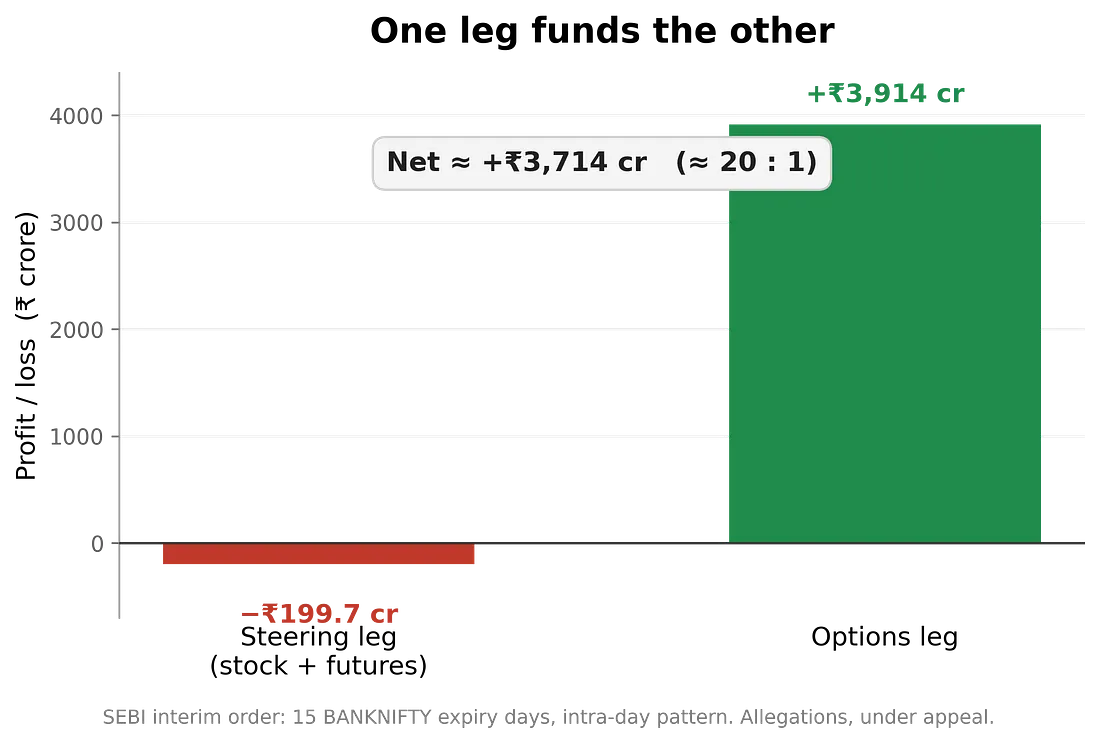
SEBI's figures have exactly this shape. On the fifteen BANKNIFTY days of the intra-day pattern, the order puts the loss on the steering leg, the stock and futures traded to move the index, at about ₹199.7 crore, against roughly ₹3,914 crore of index-options gains: close to twenty to one. The leg that moves the market is meant to lose money; the options leg it sets up is meant to dwarf that loss. That, and not sheer size, is the condition the strategy needs.
There is a legal fault line running right under the mathematics, and it is the part of the affair I find most uncomfortable, maybe because I spent years on the legal side of exactly this line. The same average an honest trader forecasts, a manipulator steers. Mathematically the only difference is which variable you treat as given, the price path or your own position in it. That is a thin line, and I stood on the right side of it knowing how thin it was.
Indian law does not make it thicker. The PFUTP Regulations prohibit fraudulent and manipulative dealing, but the boundary turns heavily on intent and effect, and intent cannot be read off a trade directly. SEBI inferred it from structure, above all the 7.3:1 delta imbalance: a book whose options exposure dwarfs its cash hedge by that much is, the regulator argued, not hedging but betting on the direction it was itself pushing. That is a claim that the position was built to profit from the settlement it moved, rather than to neutralise risk. The imbalance is the intent, inferred from the trajectory.
That inference is the whole case, and it is what Jane Street contests, arguing it was denied the documents to rebut SEBI's reconstruction and that an earlier SEBI inspection had found no manipulation. Whether a delta ratio and a sequencing pattern establish manipulative intent, as against vigorous but lawful trading, is what the tribunal now has to weigh.
Be precise about this. The 3 July 2025 order is an ex-parte interim order, not a final adjudication. Jane Street deposited the ₹4,843.57 crore into escrow, the trading restraint was lifted on compliance, and in September 2025 the firm appealed to the Securities Appellate Tribunal, which admitted the appeal, told SEBI to explain why it had withheld certain documents, and paused personal hearings, delaying SEBI's confirmatory order. The hearings ran into early 2026 and were adjourned, most recently on 25 February 2026, leaving the interim order and the deposit in abeyance and the substance unresolved.
So the honest one-line status: a very large interim order, complied with under protest, under live appeal, with no final finding and no confirmatory order, and no further ruling reported since February 2026. The case is sub judice, and the precedent it may set (on document access, on proving inferred intent, and on how far a regulator can read manipulation off trade structure) is precisely why it is being fought this hard. Confirm the latest status before citing it.
A market's deepest properties often live in a definition almost no one reads. For three decades the choice to settle Indian index derivatives on an average rather than on the close decided everything: it gave the patient trader a convergence edge, it smeared expiry gamma into harmlessness, it defeated the cheap manipulator with a single print, and it handed the manipulator with a balance sheet a clean, convex, D²-scaling lever, on a market whose thin cash leg and deep options book supplied exactly the leverage it feeds on.
The same average that rewarded patience rewarded scale. The reform going live on 3 August 2026, which the first post describes, punishes neither: it replaces the thirty-minute average with a single closing auction, and the manipulation loses its lever, because dragging an average needs a window to work over and a single auction uncrossing gives you none. The strategy optimises against a settlement that no longer exists.
After August 2026 the last half hour is no longer an average you can forecast or a window you can lean on. It is a point, and points are much harder to push. I will miss the average, a little. It rewarded the kind of patient arithmetic I loved. But I understand why it had to go.
This is the final part of the series on VWAP settlement. The first part derived the settlement and the closing-auction reform; the previous part, the mathematics of marking the close.
All figures attributed to SEBI reflect its 3 July 2025 interim order and reporting on it, not adjudicated fact; the matter is under appeal and unresolved as of the February 2026 hearing. Verify the current status and the specific figures before publishing.
