
Every order you have ever sent to an exchange did exactly one of two things: it waited, or it crossed. There is no third kind. An order that waits sits in the book at a price of its choosing, hoping the market comes to it. An order that crosses pays whatever price is already sitting there, because it cannot afford to wait. The label on the ticket does not matter; priced through the touch, it crosses.
The one who waits is called a market maker. The one who crosses is called a market taker. Everything in modern market structure is downstream of the tension between these two roles: the colocation racks, the microwave towers, the enforcement orders, the auction reforms of last season. And the gap between the maker's two prices is the most honest number in finance: the price of impatience.
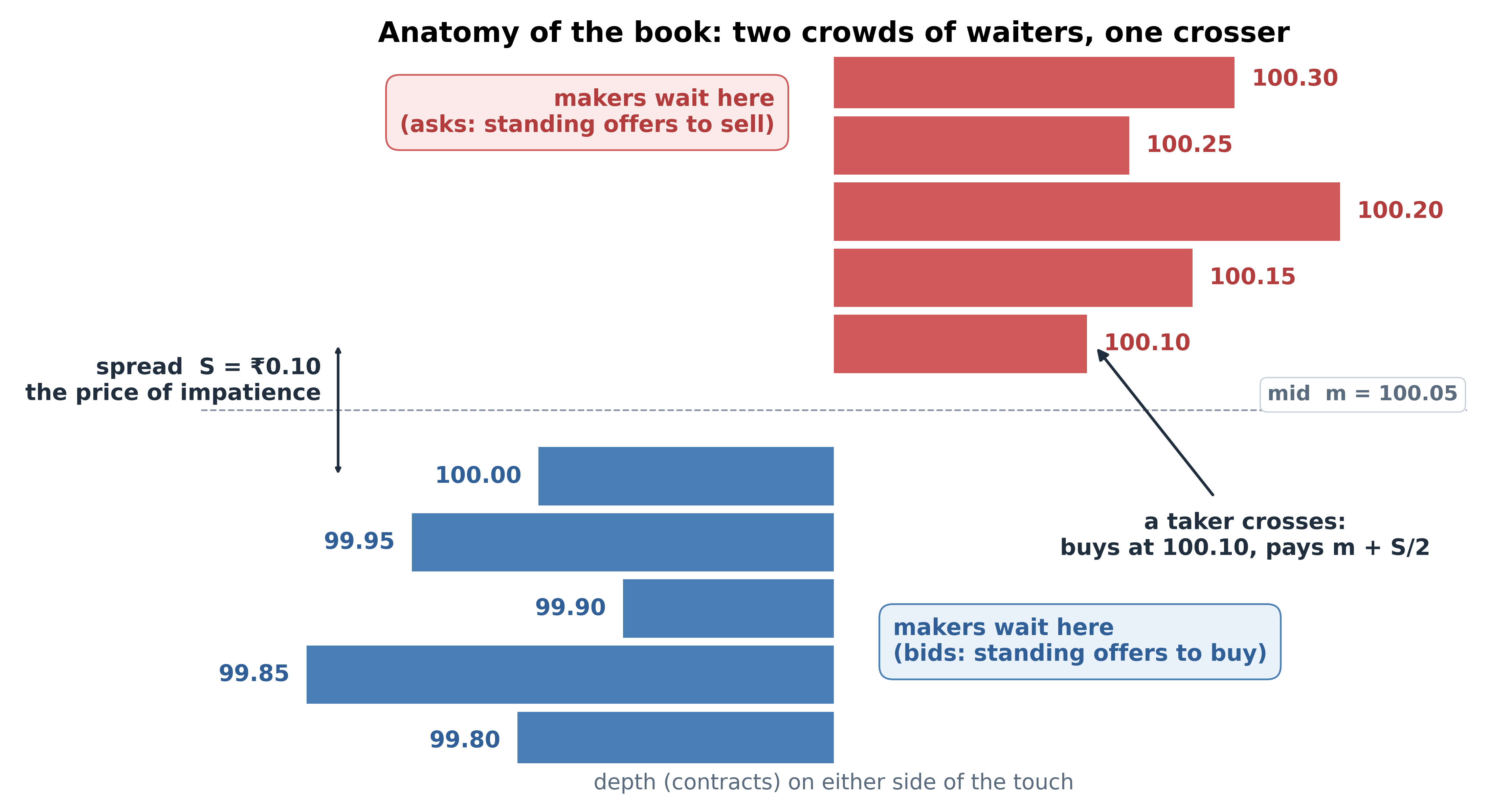 Anatomy of the book. Two crowds of waiters, bids below and asks above, and the gap between the best of each is the spread. A taker is anyone who refuses to join either crowd and crosses the gap instead, paying half of it for the privilege of trading now.
Earlier in this series I priced the free option inside every resting quote and showed why the front of the queue is worth paying for; this post and the next put those pieces inside the head of the person quoting the two prices. Today the anatomy, next post the equation.
Go to the APMC yard at Vashi before dawn and find a tomato wholesaler. Call him Tukaram. Tukaram performs a magic trick. He will buy your tomatoes at ₹98 a crate, all morning, from anyone. He will sell you tomatoes at ₹102 a crate, all morning, to anyone. He does not particularly care whether tomatoes are a good investment. He is not forecasting the monsoon. He simply stands there with two prices, and every time a crate passes through his hands in one door and out the other, four rupees stay behind.
Watch him for ten minutes and you will conclude the margin is free money. Watch him for a week and you will discover his two nightmares. Everything a Nifty options market maker does, at nanosecond speed, with Greek letters, is Tukaram managing those same two nightmares.
Formally: Tukaram quotes a bid b (the price at which he buys) and an ask a (the price at which he sells), with a > b. The midpoint m = (a + b)/2 is his working estimate of what a crate is really worth. The spread S = a − b is his gross margin per round trip. The whole of market making is the choice of a and b, refreshed continuously, under uncertainty. The next two sections explain why that sentence is not as trivial as it sounds.
Tukaram's first nightmare is the truck he is stuck with at closing time.
Buying at 98 and selling at 102 only earns the spread if the buys and the sells arrive in roughly equal numbers. Some days they do not. Some days everyone is selling tomatoes and nobody is buying them, and Tukaram goes home the involuntary owner of three hundred crates. Overnight, the price of tomatoes will move for reasons that have nothing to do with him: rain in Nashik, a festival, a fuel strike. His four-rupee margins are now hostage to a directional bet he never wanted to make.
This is inventory risk, and its mathematics is the simplest in this post. Suppose Tukaram holds q crates overnight and the overnight price change is a random variable with standard deviation σ. His overnight profit and loss is q times that price change, so:
 variance of overnight P&L is q²σ², so the standard deviation is |q|·σ.
The standard deviation of his P&L grows linearly in the position, but the discomfort grows faster than that, because risk limits, margin calls and sleep are all sensitive to the square. A maker holding 300 crates does not feel three times as bad as one holding 100 crates; he feels roughly nine times as bad. That quadratic penalty on q is not a metaphor. It is the exact term that will sit inside the objective function next post, and it is why every maker on earth does what Tukaram does when the crates pile up: move both prices.
Long three hundred crates, Tukaram cuts his ask to 101 to attract buyers, and cuts his bid to 97 to discourage more sellers. Both quotes shift down together. He has not changed his opinion about tomatoes; he has changed his opinion about his own inventory. In the language of the next post, his reservation price has fallen below the market mid. The skew is the position talking.
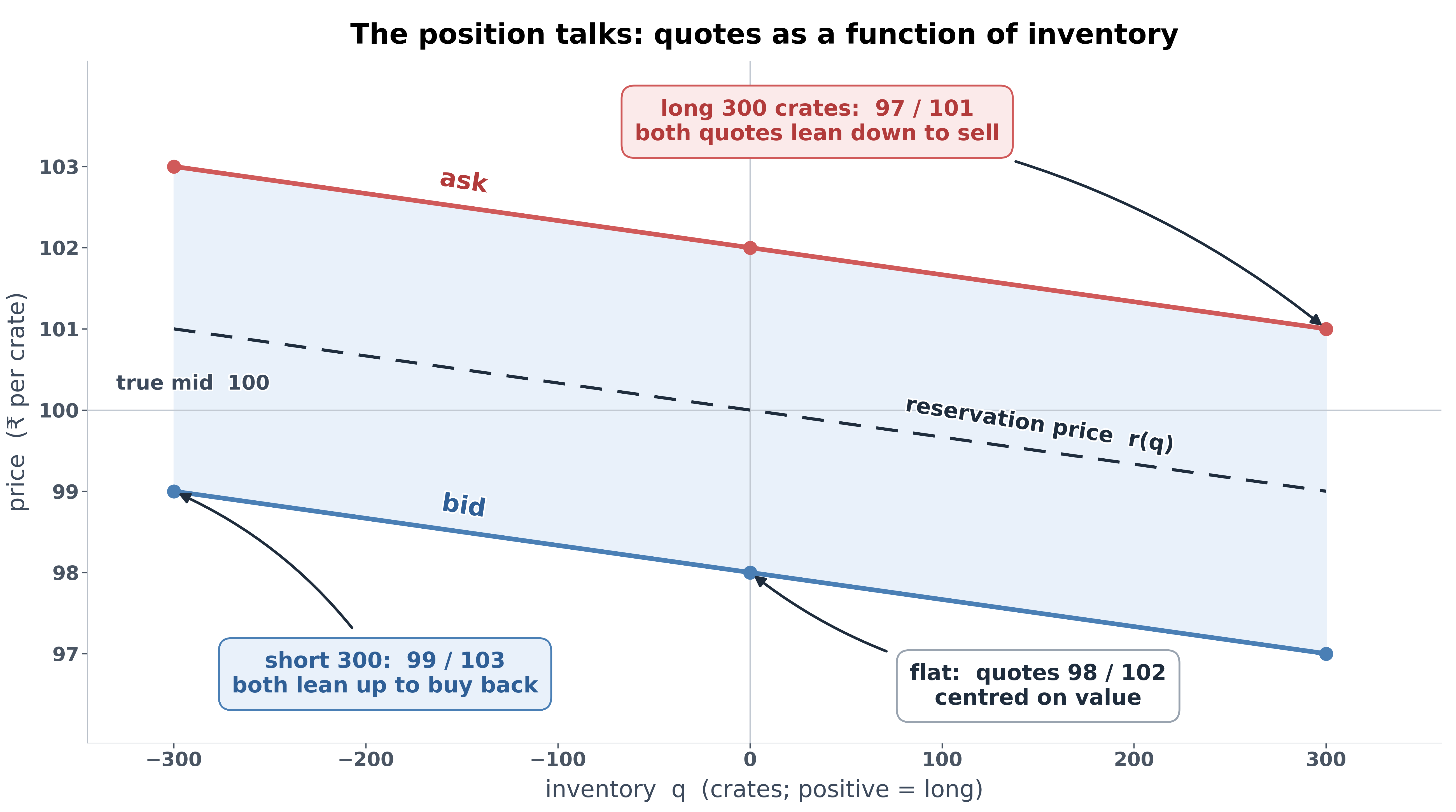 The position talking, drawn. As inventory grows, both quotes slide down the dashed reservation-price line: Tukaram flat quotes 98 / 102, Tukaram long three hundred crates quotes 97 / 101, Tukaram short three hundred quotes 99 / 103. The spread stays the same width; the whole window moves. This straight line is the hand-drawn version of a formula we will derive properly next post.
Tukaram's second nightmare is quieter and far more expensive.
One morning a commission agent walks up and, without haggling, buys every crate Tukaram will sell at 102. Then his associate buys more. Twenty minutes later the yard learns that an overnight landslide has closed the Nashik highway and no trucks are coming for two days. Tomatoes reprice to 130 by lunch. The agent, it turns out, has a cousin at the highway checkpoint who called him at 5 a.m.
Tukaram did not lose because his margin was too thin. He lost because his counterparty was not a random customer; his counterparty was selected against him. The people most eager to trade with a posted price are precisely the people who know the price is wrong. This is adverse selection, and it is the deepest idea in market microstructure. The resting quote is, as we priced it in the first post of this series, a free option written to the whole world, and the world exercises options only when they are in the money.
Notice what this nightmare does to the meaning of the spread. Nightmare One says the spread compensates Tukaram for warehousing risk he does not want. Nightmare Two says something stranger: the spread is a toll, collected from the many customers who know nothing, to pay for the losses inflicted by the few who know something. Tukaram is not the villain of the mandi. He is the toll booth. The informed levy the tax; he merely collects it from everyone and passes it through.
That claim sounds like table talk. It is actually a theorem, and it fits in a paragraph.
Here is the single most useful toy model in this subject, due to Glosten and Milgrom (1985), staged entirely in the tomato yard.
Tomorrow a crate of tomatoes will be worth either ₹95 or ₹105, with equal probability: the highway either reopens or it does not. Today's fair value is therefore ₹100. A fraction π of the customers approaching Tukaram are informed: they already know tomorrow's number (they have cousins). The remaining 1 − π are ordinary uninformed customers who buy or sell with equal probability for their own reasons: a wedding order, an overstocked stall, a cancelled contract.
Tukaram cannot tell the two types apart. All he observes is the direction of each trade. And the mandi is competitive: a dozen wholesalers stand in the same row, so none of them can quote a spread fatter than survival requires. Competition forces each price to be exactly fair given what the trade itself reveals:
 the ask is the expected value of the crate conditional on the next trade being a buy; the bid, conditional on it being a sell.
Read that twice, because it is the whole trick. Tukaram's ask is not "fair value plus margin." It is the answer to a question: given that someone just chose to buy from me, what is a crate worth? A buy is evidence. Informed customers buy only when the truth is 105; uninformed customers buy half the time regardless. So a buy tilts the odds toward 105, and Bayes' rule tells us by how much:
 the conditional expectation worked out: the probability a buy comes given V = 105 is (1+π)/2, given V = 95 it is (1−π)/2, and the algebra collapses to a = 100 + 5π.
By symmetry the bid is b = 100 − 5π, and the spread is:

Put numbers in it. If one customer in five has a cousin (π = 0.2), Tukaram quotes 99 bid, 101 ask: a two-rupee spread. If half of them do (π = 0.5), he quotes 97.50 at 102.50: a five-rupee spread. And if nobody has a cousin (π = 0), competition grinds his spread to zero and Tukaram earns nothing at all. "Riskless spread capture" in a market with no informed flow is not a strategy; it is a contradiction. The margin exists because the cousins exist.
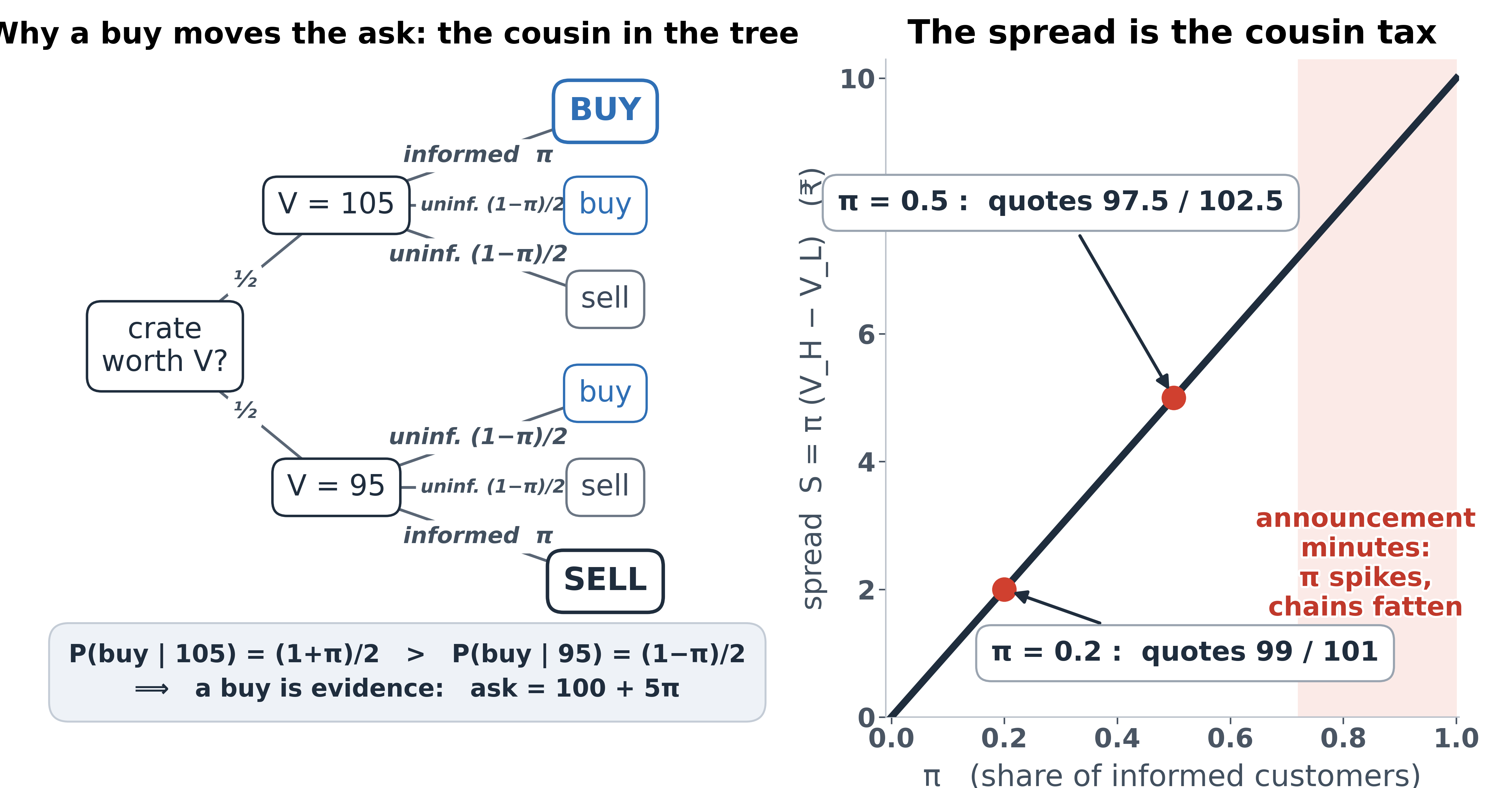 The whole model in one picture. Left: the probability tree. A buy can arrive down three paths, and two of them run through the V = 105 branch, which is why a buy is evidence and the ask must sit above 100. Right: the resulting spread law, a straight line in π. The two red dots are the worked examples from the text, and the shaded zone is every pre-announcement window you have ever watched an option chain fatten in.
Now swap the costumes. Replace the crate with a Nifty weekly call, replace the landslide with an RBI statement or a large fund's rebalancing order, replace the cousin with anyone whose information or speed lets them act before the quote updates. Nothing in the equation changes. The bid-ask spread you pay on that option is, to first order, π times the size of the move the informed are trading ahead of. When you pay the spread, you are not paying the market maker's salary. You are paying your share of the toll that the informed extract from the pool, with the maker standing at the booth.
This is also why spreads breathe with the clock: before a policy announcement π rises and V_H − V_L widens, and every option chain fattens at once. The makers have not become greedier at 1:55 p.m. The equation has.
One honest caveat. In this competitive toy model the maker earns zero in expectation: spread income from the uninformed exactly funds the losses to the informed. Real makers eat because of a short list of edges over that baseline: knowing when π is temporarily low, standing earlier in the queue, managing inventory better than the quadratic penalty demands. Which brings us to the ledger.
The quoted spread is an advertisement, not an income statement. For what a maker actually keeps, microstructure has a decomposition worth knowing even if you never quote a price in your life. Take a trade at price p with direction d (+1 if the taker bought, −1 if the taker sold), let m_t be the mid at the moment of the trade, and m_{t+Δ} the mid a little later, after the market has had time to react:
 effective spread = realized spread + price impact.
The effective spread, 2d(p − m_t), is what the taker paid relative to fair value at the instant of trade: the toll as posted. The price impact, 2d(m_{t+Δ} − m_t), is how far the price moved in the taker's direction afterwards: the footprint of information. What is left, the realized spread, is the maker's actual gross earning on the trade. When the highway agent bought at 102 and tomatoes went to 130, the toll as posted was ₹2 per crate, the impact was ₹28, and what Tukaram kept was minus twenty-six rupees a crate (the identity doubles these by convention; the anatomy is the same). The posted toll and the earned toll are different numbers, and the difference is exactly Nightmare Two.
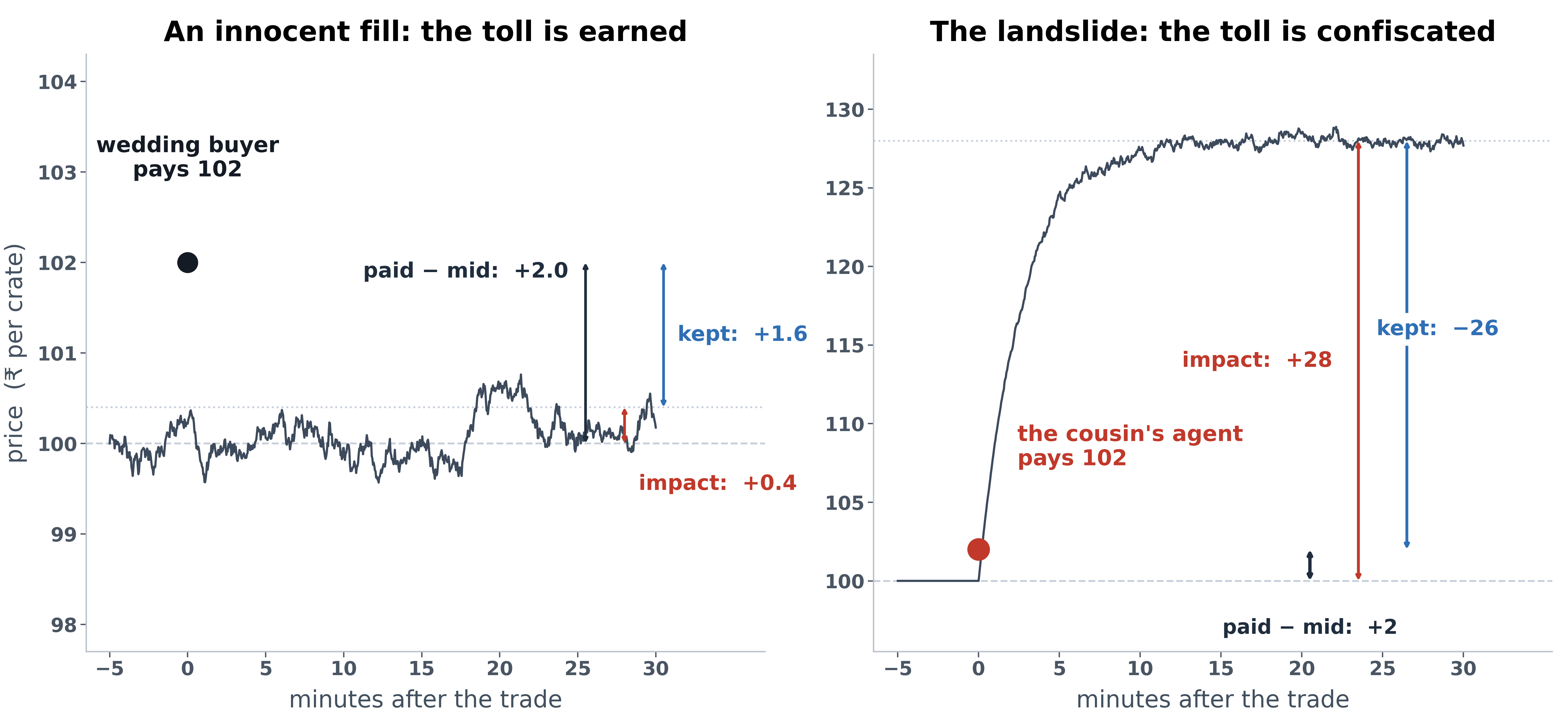 The same trade, two fates. Left: a wedding buyer pays 102, the price barely moves, and the maker keeps roughly the toll he posted. Right: the cousin's agent pays 102, the landslide news lands, and the ₹2 toll is confiscated along with ₹26 more. The maker cannot tell these two customers apart at the moment of the fill. That is the entire problem.
Stack every trade of the day and you get the maker's ledger as an accounting identity:
 day P&L = spread capture − adverse-selection losses + inventory P&L − fees.
I simulated one NSE session of this ledger to make the identity visible: a maker quoting a 10-paise spread around a drifting fair value, a steady stream of uninformed fills, twelve informed pick-offs during the day, and the crude inventory leash from Nightmare One.
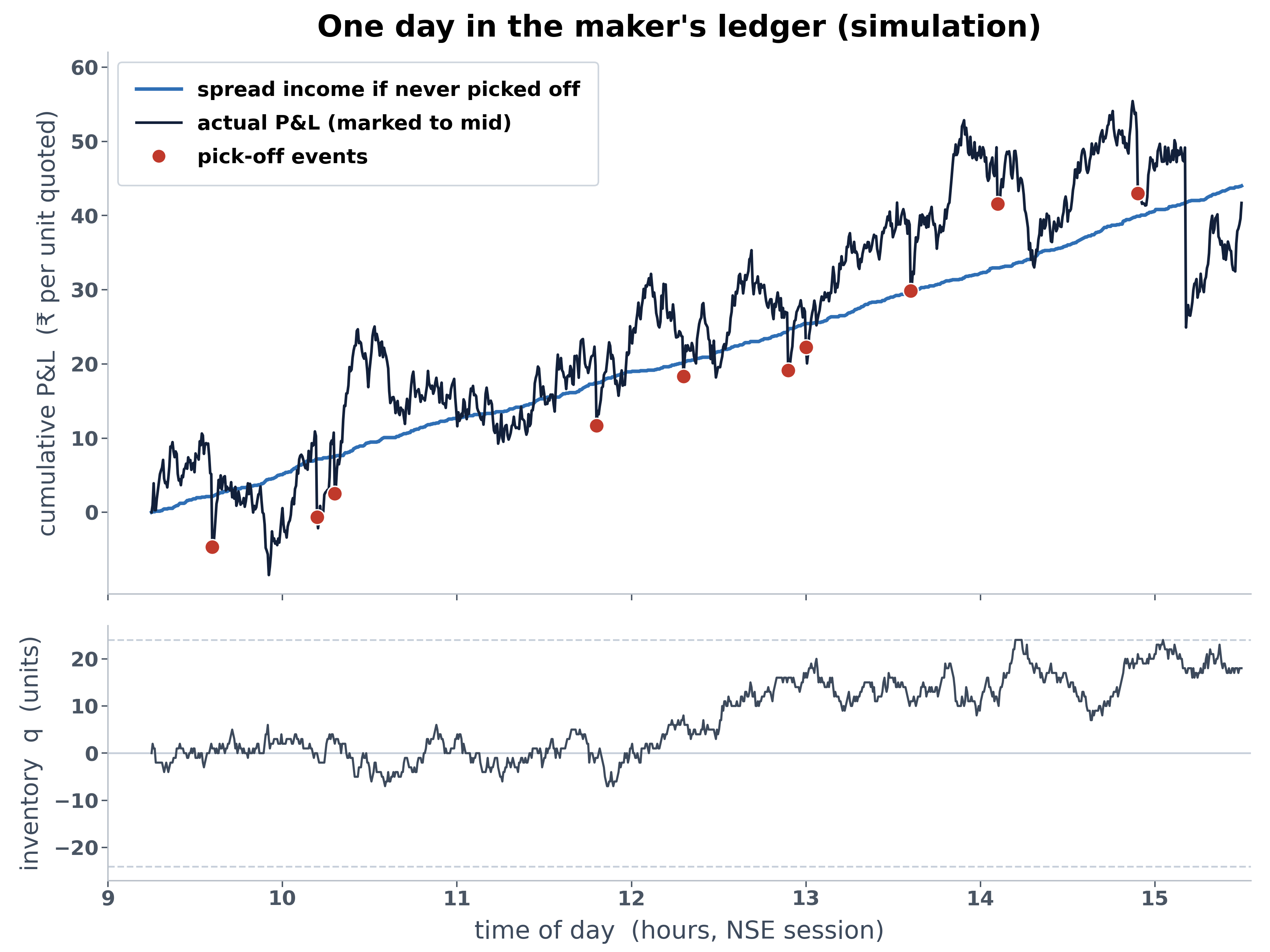 One day in the maker's ledger (simulation). The blue line is what the maker would earn if every fill were innocent: roughly 890 fills at 5 paise of half-spread each, about ₹44 of spread capture. The black line is the P&L that survives contact with reality: each red dot is a pick-off, an informed trade that hits a stale quote just before the price jumps, and the day ends near ₹34. The gap of about ₹10 is the toll passed through to the informed. The lower panel shows the inventory being yanked back inside its band all day: the position never stops trying to run away, and the maker never stops leashing it.
Look at the shape of the black line and you will understand the psychology of the profession. Market making is a business of collecting coins in front of an irregular steamroller: long stretches of small, boring, almost mechanical income, punctured by sharp losses that arrive precisely when something true is happening. The craft is not avoiding the steamroller, which is impossible while quoting continuously. The craft is sizing the coins so that they pay for it.
By this point the taker may sound like the sucker at the table. Wrong, and every working trader knows it, because every working trader is a taker many times a day, on purpose, at full price. The kirana near your house sells tomatoes at night for double the Vashi morning rate and you pay it gladly; what you are buying is not tomatoes but immediacy, and the spread is the retail markup on time.
The arithmetic is one line: cross whenever your expected loss from waiting exceeds the half-spread S/2, remembering that a resting order is itself the free option this post is about. A hedge due before an announcement, a stop-loss that exists to be executed: crossing there is discipline, not impatience. The maker sells time, the taker buys it, and everything else in this series (the races, the queues, the auctions) is a fight over the terms of that one trade.
Here the Indian story stops rhyming with the American one.
The American ecosystem descends from privilege: the NYSE specialist and the NASDAQ dealer were obligated makers with a protected franchise, and when electronics dissolved the franchise, the exchanges invented maker-taker rebates to pay for quotes instead. A monopoly that evolved into a subsidized competition.
India took neither step. The BSE ring had its jobbers, two-way men shouting prices in the crowd with badla financing behind them, but when NSE switched on its screens in November 1994 and BSE answered with BOLT the following year, the floor's franchise simply died. What replaced it was an anonymous limit order book in which making is voluntary: no designated market makers in the index option chains, no maker-taker rebates funding passive quotes across the market. Nobody in the Nifty book is paid a rebate to stand there.
The one instrument India does have is the Liquidity Enhancement Scheme, a time-bound, exchange-run programme that pays designated participants for quoting obligations in specified illiquid securities. SEBI permitted these in the derivatives segment in June 2011 and extended the framework across cash and derivatives in April 2014; a scheme may even pay maker-taker style rebates, but only on the securities it covers and only while it runs. Targeted irrigation, not a subsidy raining on the whole market. The flagship index products have never needed one: on the liquid Nifty strikes the spread sits at a few paise, and nobody is paid a rupee to hold it there.
So who is in the book? Three broad tribes. The global proprietary firms, names you would recognise from Amsterdam, Chicago and New York, running the full colocation stack from the previous posts. The domestic proprietary desks and brokers' arms that grew up native to the NSE order book and know its plumbing intimately. And a third tribe that exists at this scale nowhere else on earth, which deserves its own section.
The third tribe is retail, and they do not know they have joined the profession.
Every seller of a weekly Nifty or Bank Nifty option who posts a limit order and waits for a fill is, functionally, a market maker: they are supplying a resting quote and collecting a premium for immediacy and risk. What they are not doing is anything else the professionals do. No hedge against the delta. No model of π. No leash on the inventory. No infrastructure to pull the quote when the world changes. They are Tukaram with no sense of smell for cousins, standing in the yard on landslide morning, margin proudly posted.
The strategy even has a folk name, selling for "theta," and in the flat weeks it works exactly as advertised, which is the trap. The income is the blue line from my simulation; the product they have actually sold is the black one. SEBI's own studies of the segment keep returning the same verdict. In the 2025 fiscal year, 91 per cent of individual traders lost money, and their combined net loss came to ₹1,05,603 crore, up 41 per cent on the year before. Nine in ten, year after year, study after study. Those studies are usually read as a statement about leverage and overtrading. Read through the lens of this post, a large slice of it is something more specific: an adverse-selection transfer from unhedged, information-blind passive quotes to the participants who know, milliseconds or minutes earlier, which way the board is about to move. The toll booth works exactly as the equation says. It does not check whether the collector understands the job.
This is not a sneer. The professionalisation of the other side is recent, the invitation to retail to write options more recent still, and the gap between "selling premium" as marketed and market making as practised is the single most expensive gap in Indian retail finance. If the mathematics in this series does one genuinely useful thing, it is making that gap visible in equations before it shows up in account statements.
The race from the first post is Nightmare Two industrialised: latency arbitrage is adverse selection with better engineering, and the cousin no longer needs a checkpoint, only a shorter fibre. At microsecond speed, π stops being a slow sociological parameter and becomes something that spikes chain-wide in the milliseconds after every tick of a correlated instrument. The modern maker's central skill is not choosing the spread; it is knowing when to not be there at all.
And the previous season lives one step further down the same road. SEBI's interim order of July 2025 alleged that a major global trading firm moved the index through aggressive trading in the cash and futures legs while holding far larger opposite exposures in index options, particularly into expiry closes; the firm disputes the characterisation entirely, has deposited ₹4,843.57 crore, and the matter is before the Securities Appellate Tribunal. Every window in that order belongs to the old regime, before the closing auction that went live on 3 August 2026 redesigned the very half hour in question The CAS Effect. I wrote three posts on the case and will not relitigate it here. Strip away the numbers and it is a dispute about roles: who was supplying immediacy in that last half hour, who was consuming it, and at whose expense. You cannot have a view on the case without a view on what making and taking are. Now you have one.
Nothing else in this post cares which side of the reform you read it from: the nightmares, the cousin tax, and the ledger are identical in both worlds. What changed in August is the mechanism that matches maker and taker at the close, and whether that swap does what its designers intend is where this series is heading.
Here is the job in one sentence, which is how every good optimisation begins.
Choose two prices, every second, all day, so that the tolls collected from the impatient pay for the pick-offs by the informed and the warehousing of whatever inventory the flow leaves behind, while a dozen competitors stand in the same row quoting against you.
Every clause of that sentence is now a term you can price. The tolls: S/2 per fill. The pick-offs: π(V_H − V_L), by Glosten and Milgrom. The warehouse: the quadratic penalty in q. The competitors: the zero-profit condition that keeps S honest. What remains is to put the sentence into mathematics and solve it: to derive the two prices as functions of inventory, volatility, arrival rates and time, which is exactly what Avellaneda and Stoikov did in 2008, and what Guéant, Lehalle and Fernandez-Tapia closed in elegant form a few years later.
And when we do, we will add one term to the objective that no textbook includes, because no textbook was written from India: a levy the exchange collects on every single trade regardless of who won it. The Securities Transaction Tax quietly rewrites the maker's equation, and decides which strategies can exist in India at all.
That is the next post. Tukaram, for one, would like to see the formula. He has been solving it by feel for thirty years.
